
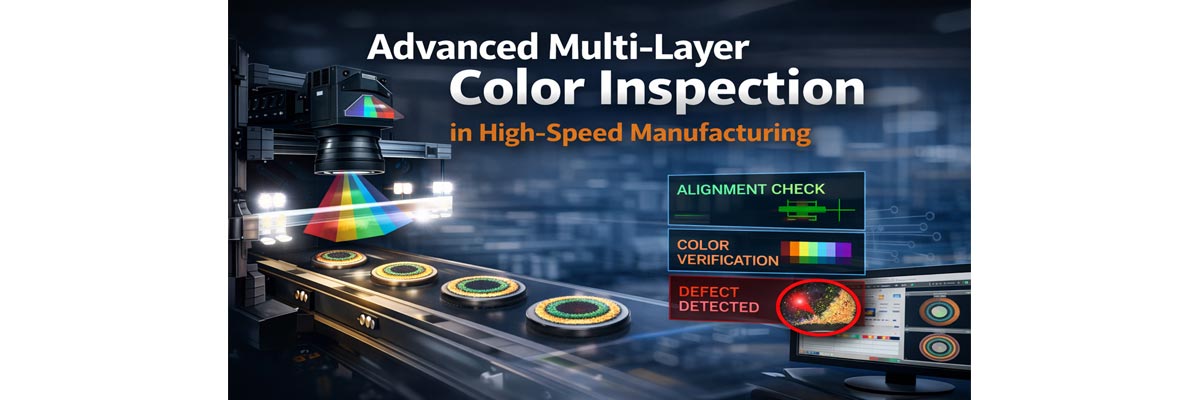
A manufacturer that produced products with multi‑layer printed color patterns found itself struggling to verify print quality, alignment, and color accuracy on its high‑speed production line. Automating inspection was a natural solution but, on its surface, not a simple one.
Inspection involved multilayered challenges, including analysis of complexly stacked print layers, accurately imaging curved surfaces, ensuring consistent color detection and geometric measurement, and maintaining accurate results during high-throughput production.
The manufacturer consulted with EZ Automation, who proposed a sophisticated but elegant machine vision system that could address all inspection tasks without compromising production speeds.
The Challenge#
The inspection application combined several difficult machine vision problems. To succeed, the vision system would need to verify print colors were correct, detect missing or incomplete print layers, measure alignment between multiple printed layers, and ensure accurate placement of the entire print pattern on the product surface. Adding to the complexity, the vision system would also need to detect debris and distortion while operating on a multi‑lane production line with strict timing constraints.
Traditional inspection methods struggle with all of these demands due to the interactions between layered print colors, surface curvature, and production speeds. Achieving reliable results requires a carefully engineered combination of imaging hardware, algorithm design, and production‑line integration.
The Solution#
To ensure accurate color detection, EZ tackled the imaging problem first. It incorporated a true RGB prism‑based color camera combined with controlled white light illumination and precision optics optimized for uniform color capture. To maintain long‑term consistency, EZ developed a standardized white balancing procedure and custom color calibration targets. Its calibration procedures ensured repeatable color measurements across cameras, production shifts, and evolving product designs.
Next, EZ developed inspection algorithms to analyze both single‑layer and multi‑layer printed patterns. This allowed the system to detect individual print layers, measure their alignment, verify concentricity, and identify defects such as debris or partially missing print. By comparing captured images to an ideal reference pattern, EZ’s system could detect subtle deviations and measure distortion caused by the printing process.
Automating inspection of the products’ curved surfaces was another challenge, as surface curvature can distort how features appear in camera images. To address this, EZ’s system leveraged distortion‑correction mapping to convert image coordinates into true physical measurements, enabling precise evaluation of print placement and layer alignment.
EZ Automation’s role did not stop with system design. It deployed the system in the manufacturer’s production environment, which required careful mechanical and software integration. Cameras were positioned inline to address space constraints while maintaining full coverage of multiple product lanes. Deterministic triggering and high‑throughput processing pipelines ensured that inspection results were accurately correlated to the correct product.
EZ’s inspection software distributed processing tasks across multiple processes to maintain stability and performance under continuous high‑volume operation.
Lastly, EZ developed a dedicated offline inspection workstation to refine, test, and validate algorithms further. This additional system allowed the manufacturer’s engineers to evaluate products from multiple angles, test algorithm updates, and analyze defects before deploying changes to the production line.
The Benefits #
EZ Automation’s system successfully enabled early defect detection, consistent color verification, and improved production insights through detailed inspection data without compromising production speeds. Moreover, the system has now reliably delivered accurate inspection and quality control for more than eight years and continues to adapt to new product revisions and print designs.
The project illustrates how EZ Automation’s advanced machine vision systems can solve complex inspection challenges even amidst high-speed production and product changes. By combining precision imaging, custom algorithms, and robust software architecture, manufacturers can achieve reliable automated inspection even for the most demanding applications.